


-

Erin Donahue -

Christina Barkanic -

Brittany Trott -

Emily Wiley -

Jessica Reilley -

Chris Raines -

Will Nichols -

Emily Reddy -

Michele Marchetti -

Michele Frank -

James Gherardi -

Kit Henshaw -

Christina and Erin -

Kim Tait -

Erin McKinney -

Steve Spanelli -

Sam Komlenic -

Katherine Taylor Grofic -

James Eisenstein -

Jamie Oberdick -

Anna Lombardo -

LacCreta Holland -

Tony Ricci -

Local Food Journey -

Laura Young -

Kristin Camplese -

Harrison's Fresh + Local -

Danielle Matalonis -

Kristine A. -

Linda Weaver -

Naomi Elle Schwartz -

Dana Stuchul -

Cara McShane -

Brittany Smith -

Jessica Illuzzi - Frosty
-

Jessica Paholsky -

James Sechrengost -

Brad Yeckley -

Maya Althouse -

Jordan Reabold -

Kim Chase -

Maria Bryant - Alexandrea Scott
Starting Seeds is Easy: How to Plant the Seeds
Posted by Jamie Oberdick on 03/23, 2012 at 12:06 PM
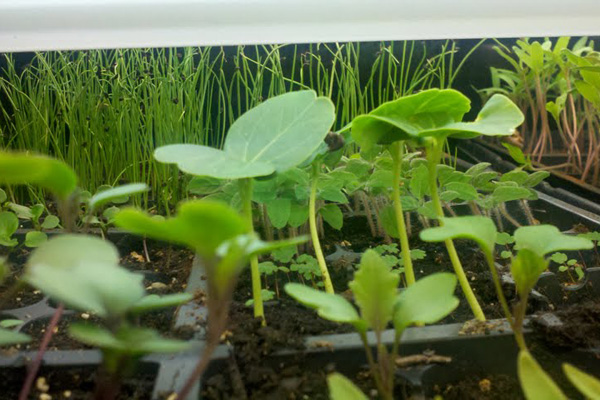
A variety of vegetable and flower seedlings getting a head start in seed flats. Photo Credit Jamie Oberdick.
If you followed my last blog post, you should be ready to plant some seeds indoors. First things first, fill your cell flats with moistened potting soil or seed starting mix. You want it moist, not saturated.
Next, plant the seeds. This is by far one of the most important tasks of your gardening year, and you need to make sure you do it correctly because, well, you want them to germinate.
Problem is, there are some variables. Some seeds like light, some seeds need to be covered. The planting depth can vary for each variety, from a light covering to up to an inch. Some seeds need to be soaked before planting, or even frozen before planting. It’s a good idea to look up each seed before planting, or check the seed packet for planting instructions.
Once planted, keep them at a fairly uniform temperature, around 70-75 degrees. Do not let the seeds dry out; use a spray bottle to keep them moistened.
After the seeds germinate, turn on the shop lights. The lights should be only 2-4 inches above the plants—any higher and they won’t get enough light. As the seedlings grow, you may need to raise the lights to keep them at least 2 inches above the plants. You also need to make sure whatever seeds didn’t germinate do not dry out.
The seedlings will pull what they need from the soil, but once they get a few sets of “true leaves,” it’s a good idea to feed them with a water-soluble fertilizer at 1/4 strength. Also, watch for damping off, a disease from soil-borne pathogens that can quickly kill seedlings. There are several ways to prevent damping off, including sprinkling cinnamon on the soil around the seedlings (cinnamon kills the pathogens) and running a fan to improve air circulation around the seedlings.
Eventually, depending on what you planted, it will be time to transplant outside. More on how to successfully do that in a future post.
One final note—some may ask, why not just buy plants? There are several reasons, including better selection. But there’s also something less tangible—it’s just more satisfying to grow vegetables from seed to harvest. Give it a try.
Author: Jamie Oberdick
Bio: Editor, Local Food Journey | Passionate about supporting local food in Central PA


- Our Local Food Journey comes to an end
- Winter isn’t a quiet time at the farm
- Get the taste of garden season right now by growing herbs indoors
- All you need to know about PASA’s Farming for the Future conference
- January is National Soup Month, so celebrate with some Local Food Journey soup recipes
- Recipe: Roasted Parsnips with Thyme
- Sure celeriac’s ugly…but it’s also delicious
- (See All Recipes)

NO COMMENTS